
What we do, and the work behind it
From the first meeting to the inspection on site. Each service opens with the work it rests on, then says what we offer.
01 / 05
Strategic convening
Our approach
The Africa Climate Summit, where our founder led partnerships and resource mobilisation.
The team’s convening experience was built at the Africa Climate Summit, where our founder, Lucy Nyoike, was Partnerships and Resource Mobilisation Lead under the Government of Kenya, and in partnership roles at GEAPP, The Rockefeller Foundation and FSD Africa.
Africa’s climate and development initiatives rarely fail because of a bad idea. They fail because the right people never came to the same table. We offer neutral convening for governments, financial institutions, development partners and private-sector actors: working groups and multi-stakeholder forums designed and facilitated to end in decisions and outputs that move institutions forward, not just conversations.
This includes
This includes
- High-level multi-stakeholder forums and dialogues
- Government and private-sector alignment sessions
- DFI and investor roundtables for deal origination
- Thematic working groups that produce actionable frameworks
- Cross-border convenings linking African markets to global capital
In the field

02 / 05
Partnership development
Our approach
Joint bidding agreements with Verst Carbon and KK Advisors, and the partnership behind the Tanzania survey.
ENKOP works with Verst Carbon and KK Advisors under joint bidding agreements. With Verst Carbon, ENKOP delivered the farmer survey for Phase 1 of the Africa Biochar Aggregation Platform, a programme that joined an FSD Africa grant, Tanzania’s National Food Reserve Agency and Verst Carbon’s platform.
Climate projects need partnerships designed on purpose, not ones that happen by accident. We structure and facilitate multi-stakeholder partnerships that bring financing, technology, knowledge and delivery capacity together, including the legal architecture, governance, benefit-sharing and accountability arrangements that let partners with different mandates and risk appetites work to one plan.
This includes
This includes
- Public-private partnership design and structuring
- Multi-stakeholder programme architecture
- Governance and accountability frameworks
- Investor-developer matchmaking and deal facilitation
- Benefit-sharing and co-investment structures

03 / 05
Project and platform development
Our approach
The 1,013-farmer feasibility survey in Tanzania, and a Kenya Wildlife Service feasibility study with Verst Carbon.
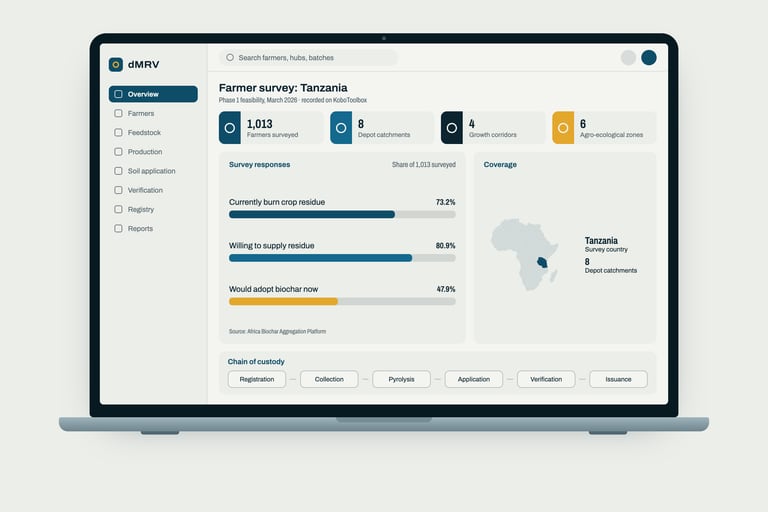
In Tanzania, ENKOP ran the 1,013-farmer survey for Phase 1 of Verst Carbon’s Africa Biochar Aggregation Platform, part of a national feasibility study completed in March 2026. In Kenya, we are supporting Verst Carbon on a feasibility study for the Kenya Wildlife Service (see Nature-based solutions, below).
Great ideas are only as good as the structures built around them. We take initiatives from first concept to a bankable, investor-ready proposal: carbon market platforms, including biochar carbon removal and nature-based solutions, blended finance vehicles, clean energy programmes and sustainable agriculture value chains, each designed to the standards of leading registries, development finance institutions and private capital.
This includes
This includes
- Carbon project development and registry structuring (Verra, Puro.earth, Isometric)
- Blended finance vehicle design and financial modelling
- Market platform development and governance
- Bankable proposal preparation for DFI and grant funding
- dMRV system design and digital monitoring frameworks
04 / 05
Market and ecosystem building
Our approach
Survey evidence on whether a biochar market can exist, and the team’s work on Uganda’s cookstove standard.
The Tanzania survey put to 1,013 smallholder farmers the questions a biochar market depends on: whether they burn crop residue, whether they would supply it, and whether they would adopt biochar. Its answers are part of the evidence base for Phase 1 of the Africa Biochar Aggregation Platform. Before joining ENKOP, our technical lead, Howard Piwang, contributed to Uganda’s national biomass cookstove standard (DUS 761).
Climate solutions in Africa scale only when the markets around them are built to support them. We work at the level of the whole system, on the policies, standards, market infrastructure and actor networks that turn individual projects into functioning sectors, from carbon market activation to clean energy value chains and regenerative agriculture finance.
This includes
This includes
- Carbon market activation and deal pipeline development
- Clean energy value chain design and market-building
- Smallholder agriculture integration into carbon and commodity markets
- Policy advocacy and regulatory engagement
- Investor ecosystem development and capital mobilisation
In the field

05 / 05
Implementation support
Our approach
The Mwea supply-chain inspection, July 2026: three of nine stages seen on site.
In July 2026 the ENKOP team went to Mwea, Kirinyaga County, to inspect the biochar supply chain for our partner Pure Plant Organics: three of its nine stages so far, the rice mill, the husk feedstock and the production site. In Tanzania, the team recorded 1,013 farmer interviews on KoboToolbox across eight depot catchments.
Strategy is only valuable when it becomes action. We bridge high-level design and delivery on the ground, working alongside local partners, cooperatives, government agencies and community structures, with project management, monitoring and evaluation, and adaptive management built in from the start, so that outcomes are measurable, scalable and locally owned.
This includes
This includes
- Project management and delivery oversight
- Local partner capacity building and support
- M&E framework design and on-site field inspection
- Stakeholder management and community engagement
- Progress reporting for DFI and donor requirements
In the field

Where finance, policy and delivery on the ground meet, and where the climate transition is decided.
The sectors where we work
Climate finance and carbon markets
Our biochar work includes a partnership with Pure Plant Organics in Kenya, for which we have inspected the feedstock supply chain at Mwea (see the July 2026 field report). We structure access to climate finance instruments and develop carbon market platforms that channel investment into high-impact projects, across voluntary carbon markets, Article 6 mechanisms, blended finance vehicles and concessional debt.
Our focus is biochar carbon dioxide removal, where much of the feedstock is still burned in the field: 73.2 per cent of the farmers we surveyed in Tanzania burn their crop residue. We design projects for registration with registries such as Verra, Puro.earth, Isometric and Riverse, and work on the commercial pathway around them, from project inception to off-take agreements with buyers.
Africa holds about 2 per cent of the global carbon market.
Source: CDR.fyi, 2026, as cited by the Africa Biochar Aggregation Platform.
Clean and distributed energy
Before joining ENKOP, our technical lead, Howard Piwang, led the design and deployment of hybrid bioenergy-solar mini-grids of up to 1 MW across Uganda, Botswana, Nigeria, South Africa and Zambia. We support Africa’s energy transition through project development, market-building and the multi-stakeholder partnerships needed to accelerate access to affordable, reliable and clean power.
We work across distributed solar, mini-grid systems, clean cooking and energy efficiency, building the deal structures and investor relationships that move projects from pipeline to financial close.
Of the 655 million people worldwide without electricity in 2024, 563 million live in sub-Saharan Africa: 86 per cent of the global access deficit.
Source: Tracking SDG 7: The Energy Progress Report 2026 (IEA, IRENA, UN Statistics Division, World Bank and WHO).
Sustainable agriculture and soil
Agriculture is one of Africa’s largest economic assets and one of its most climate-exposed sectors. We help build regenerative agriculture value chains that improve food security and restore soil health, and that are designed to generate credible carbon credits.
We work with smallholder cooperatives, processors and market off-takers on integrated platforms that give farmers access to premium markets while delivering measurable climate co-benefits.
From the farmer survey ENKOP ran in Tanzania for Phase 1 of Verst Carbon’s Africa Biochar Aggregation Platform: 1,013 smallholder farmers across eight depot catchments, March 2026. Read the field report: the ABAP farmer survey
| Response | Share of 1,013 surveyed |
|---|---|
| Currently burn crop residue | 73.2% |
| Willing to supply residue (Cash, barter or in kind) | 80.9% |
| Would adopt biochar now (77% including those who answered “maybe”) | 47.9% |
Source: Africa Biochar Aggregation Platform.
Nature-based solutions
Africa’s forests, wetlands and savannahs represent an extraordinary natural capital asset. We help develop and structure nature-based solution projects, including REDD+, avoided deforestation and biodiversity credits, designed to generate durable climate benefits while creating tangible livelihoods for local communities.
We design these projects around the integrity standards and community governance structures that modern buyers and investors require.
Supporting Verst Carbon on a Kenya Wildlife Service feasibility study into carbon project potential across Kenyan protected areas, covering ESG, safeguards and implementation.
Water security and climate resilience
Water stress and climate-driven disruption are increasingly intersecting threats across East and sub-Saharan Africa. We offer to convene multi-stakeholder programmes around water security that integrate climate adaptation finance, infrastructure investment and watershed governance.
That includes structuring adaptation finance instruments, developing resilience platforms, and facilitating the government and private-sector partnerships needed to finance climate-resilient water infrastructure at scale.
Digital innovation and AI for climate
Much of the cost of climate finance in frontier markets is the cost of proof: who farmed what, where, and with what result. Our carbon markets lead, Zecharia Mwangi, worked on digital MRV systems in carbon removal project development before joining ENKOP, and the Tanzania survey was recorded digitally, on KoboToolbox.
We help design tools for climate finance intelligence, dMRV systems and market platforms built to work at continental scale, and support the adoption of climate data infrastructure that lowers the cost of deploying climate finance.
Field work
The work behind the services
-

Inspecting the supply chain
Biochar carbon removal only holds up if the feedstock behind it is real, traceable and consistent. In July 2026 the ENKOP team travelled to Mwea to inspect both ends of that chain for our partner Pure Plant Organics.
-
Surveying 1,013 farmers in Tanzania
For Phase 1 of Verst Carbon’s Africa Biochar Aggregation Platform, ENKOP ran 1,013 farmer interviews across eight National Food Reserve Agency depot catchments in Tanzania. Phase 1 was completed in March 2026.
Start a conversation
Tell us about your challenge or opportunity. We reply within two working days.